
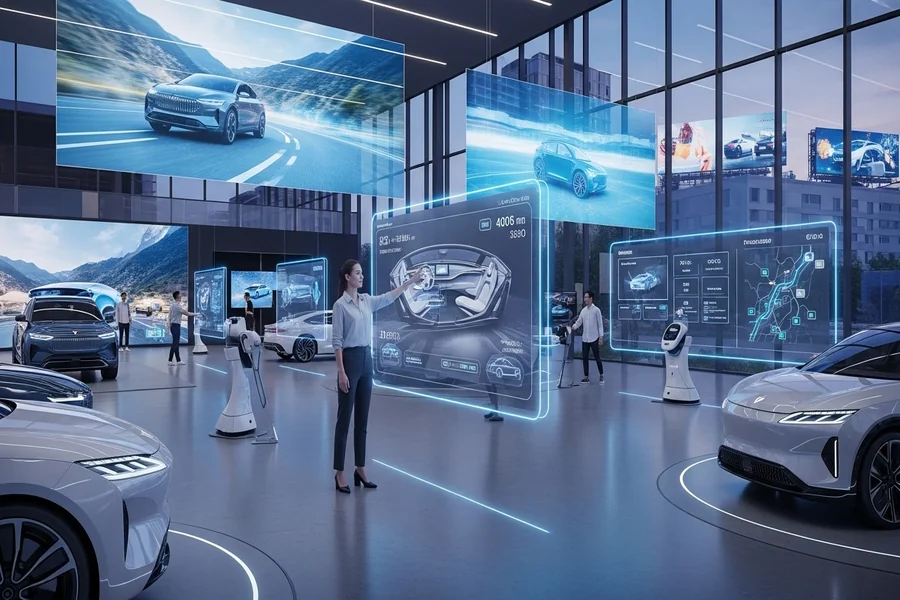
The global automotive industry finds itself at a pivotal juncture. As it accelerates toward a future shaped by electrification, software‑based innovation, AI, and new ownership models, 2026 stands to be a watershed year. Traditional boundaries between vehicles, digital ecosystems, energy infrastructure, and mobility services continue to blur — reshaping how vehicles are built, sold, driven, and monetized.
Electrification Remains Central — but Challenges Persist
Electric vehicles (EVs) are no longer an experimental segment — they are mainstream business priorities for virtually every major automaker. Manufacturers worldwide are pushing deeper into EV lineups, aiming to transition fleets and meet tightening emissions standards. Market projections show substantial continued EV market growth, driven by declining battery costs, improved charging infrastructure, and supportive policies.
Yet, the transition is complex. In Europe, for instance, carmakers are actively lobbying for more flexible electrification policies — arguing rigid timelines could harm industry competitiveness due to lagging EV demand in certain regions, underdeveloped charging networks, and high costs.
Despite headwinds, EV adoption trends in 2026 are expected to further increase, with residual values stabilizing as buyer confidence grows and charging infrastructure expands.
Software‑Defined Vehicles and Digital Architecture Take the Lead
One of the most profound technological shifts in the industry is the rise of Software‑Defined Vehicles (SDVs). SDVs decouple the software experience from hardware limitations, enabling features such as over‑the‑air (OTA) updates, advanced driver assistance, connected services, and subscription models for in‑car capabilities. The global SDV market is forecasted to reach hundreds of billions by 2026, reflecting a transformation in how value is created within modern vehicles.
Automakers are increasingly integrating cutting-edge components, including progressive chassis suspension from Melbourne, to enhance ride quality and handling, demonstrating how hardware innovations complement software advancements.
The move toward SDVs means vehicles will increasingly resemble mobile computing platforms that evolve over time. This shift underpins trends like:
- Connected services and digital ecosystems, where data becomes an ongoing revenue stream
- Feature upgrades on demand, where consumers can add capabilities after purchase
- Smarter safety and navigation systems, continuously refined via software
However, with software at the core comes increased importance on cybersecurity, privacy frameworks, and regulatory compliance—areas that industry research, such as the Momentum Cyber trends report, highlights as critical challenges in the software era.
AI and Automation Reshape Both Factories and Vehicles
Artificial Intelligence (AI) is transforming automotive operations from factory floors to vehicle behavior. In manufacturing, AI‑driven tools such as digital twins, real‑time analytics, and predictive quality control are advancing production efficiency and operational resilience.
Notably, Hyundai’s new AI‑centric smart factory in the U.S. illustrates how automakers are deploying robotics, machine learning, and autonomous inspection systems at scale — increasing flexibility and lowering costs in EV production despite global supply volatility.
AI also plays a growing role inside vehicles. Companies like Rivian are developing proprietary AI chips to support advanced autonomous systems and real‑time decision‑making — positioning software not just as an add‑on but as a competitive core capability.
Autonomy Moves Forward — Slowly but Significantly
While fully autonomous cars remain a longer‑term vision, 2026 will see significant advances in advanced driver assistance systems (ADAS) and early forms of autonomy. Collaborative technologies such as Qualcomm‑BMW automated systems are already marketed with hands‑free highway capability — precursors to higher autonomy levels.
Simultaneously, robotaxis — autonomous ride‑hailing vehicles — are expanding in select global cities, demonstrating both public interest and regulatory experimentation.
These developments signal a gradual but unmistakable shift: autonomy is becoming integrated into real transportation systems rather than remaining an R&D novelty.
Supply Chain Resilience and Sustainability Are Competitive Imperatives
The automotive industry’s 2026 strategies increasingly focus on resilient, transparent, and sustainable supply chains. ESG (environmental, social, governance) compliance is no longer an abstract objective — it’s a competitive advantage. Manufacturers are localizing battery production, standardizing traceability of raw materials, and building circular material ecosystems to mitigate risk and manage costs.
However, economic pressures persist. In Europe, sluggish vehicle demand and structural shifts have led to notable job losses among spare parts suppliers, spotlighting the broader socio‑economic impact of the industry’s transition.
New Business Models: From Ownership to Services
Automakers are expanding beyond the traditional sales model into mobility services and vehicle subscriptions. These models bundle insurance, maintenance, and even feature upgrades into a single package, aligning with changing consumer preferences for access over ownership.
Meanwhile, digital retailing continues to mature. By 2026, most dealer networks are expected to operate sophisticated omnichannel buying experiences, integrating AI‑driven tools for personalization, financing, and trade‑ins — reducing friction in the purchase journey.
Data and Connectivity Unlock New Value
Vehicles are generating more data than ever before — from in‑car behavior and sensor performance to charging patterns and predictive maintenance signals. In 2026, connected vehicle data will transition from operational use into a core revenue stream, enabling OEMs and service providers to offer premium digital services.
As this happens, regulatory frameworks for data governance and privacy will shape not just what services are possible, but how they are monetized — requiring automotive companies to balance innovation with compliance.
Energy Ecosystems and EV Infrastructure Expand
The intersection of vehicles and energy markets is becoming more pronounced. Late adopters of EVs are catching up on charging infrastructure, with rapid growth in public charging networks.
Moreover, automotive players are entering energy markets directly — offering bundled electricity plans, power‑management software, and even vehicle‑to‑grid services. These strategies aim to make EV ownership more convenient and cost‑effective, integrating vehicles into broader energy ecosystems.
Conclusion — A Year of Integration and Innovation
The automotive industry in 2026 is at the crossroads of electrification, digital transformation, and new mobility paradigms. While significant challenges like infrastructure gaps, regulatory uncertainty, and economic pressures remain, the pace of technological and business model evolution is profound.
Electrification continues to redefine vehicle portfolios; software and AI are transforming both product and process; new service models challenge the traditional ownership paradigm; and data connectivity opens vast commercial opportunities. Together, these trends indicate that 2026 will not just be a year of incremental change — but a defining chapter in the automotive sector’s ongoing reinvention.
