
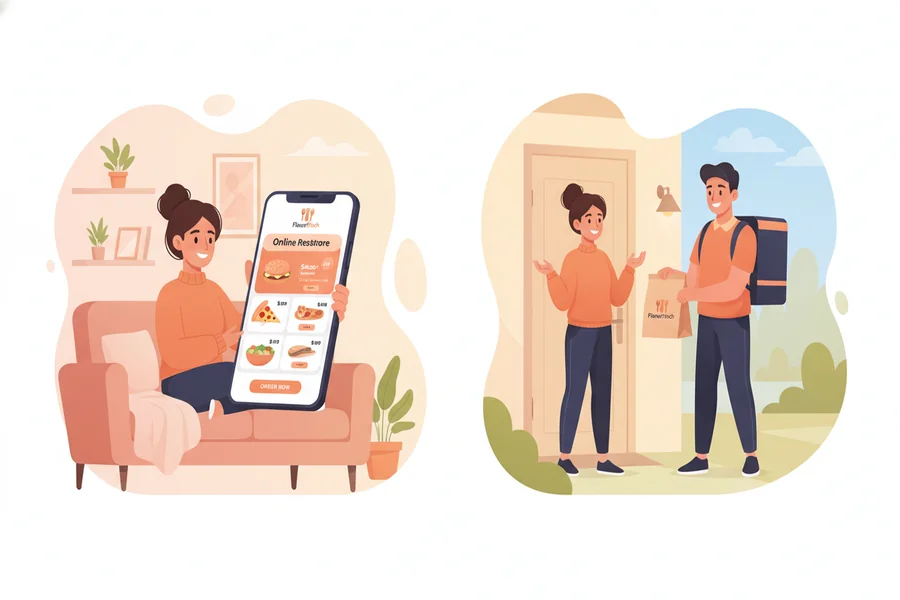
Online ordering is no longer a bonus feature for restaurants; it’s a core revenue channel.
Customers expect to browse menus, customize meals, and place orders in seconds. Yet many restaurants rely heavily on third-party apps like Uber Eats paying high commissions while losing access to valuable customer data.
Over time, this dependence eats into restaurant profit margins and weakens brand ownership.
A restaurant webstore changes that equation. It allows owners to sell directly to customers, control the entire brand experience, and keep more of every order. Think of it as your restaurant’s own digital storefront, just like restaurant ecommerce, especially for food.
In today’s competitive market, owning your online channel isn’t optional. It’s essential for sustainable growth and long-term profitability. Also it is important that your back of house software and front of house is connected and is in perfect sync with your restaurant POS system.
While we talk about it, what exactly is a restaurant webstore?
What Is a Restaurant Webstore?
A restaurant webstore is an online portal where your diners can order food online without relying on third-party applications.
Customers can browse the menu and customize or pair items together. They can order food dropped to their doorstep. Or else, they can reserve tables for dine-in and pay for all of this online.
It differs from Uber Eats and DoorDash. These apps ask for anywhere around 30% in commission. It means if your order total is $50 you get only $35 as the bottom line.
Therefore, if food delivery apps are marketplaces, your restaurant webstore is your own Amazon store.
Why Restaurant Owners Are Moving to Webstores
Today’s customers or diners look for convenience more than price. They order for pickup or delivery. You can leverage this trait by launching your webstore and saving money spent on 3rd-party applications.
Here are a few reasons why you should move to a webstore:
- Zero or lower commissions: You have commission-free ordering and snowball money saved into thousands of dollars (or even more).
- Ownership of customer data: Since you have direct access to customers’ emails, phone numbers and order history, you can remarket to the customers or enroll them in loyalty programs.
- Full brand control: There isn’t any competitor eyeing your menu. You can launch custom branding and personalized photos and items’ promotion.
- Better guest experience: All your customers’ experience is owed to you. There is faster ordering, fewer errors and consistency in pricing.
What Should a Modern Restaurant Webstore Include?
Now that you know why you should move to a webstore, let’s understand what this webstore must include:
- Seamless menu and customization:
-
- Include modifiers, add-ons or dietary preferences, viz., choose spice level (mild / medium / spicy) or bread type (white / wheat / gluten-free).
- Check for real-time availability of items.
- Integrated payments and checkouts:
- Include fast checkout via cards and wallets.
- Incorporate mobile-first checkout.
- Pick-up, delivery and dine-in ordering:
- Be scheduled-order friendly i.e. choose your date and time.
- Give room for order instructions.
- Give multiple fulfillment options like pickup, curbside pickup, dine-in reservation + preorder, and home delivery.
- POS & kitchen integration:
- Order should go directly to POS & KDS.
- There is no manual entry to take orders.
- Since the orders are reflected in KDS, there is no order missed.
- Built-in marketing tools:
- Include promo codes, enable upselling and cross-selling, and offer loyalty programs.
Restaurant Webstore vs Third-Party Delivery Apps
Third-party applications differ significantly from restaurant webstores. Here’s a table distinguishing their aspects:
| Aspect | Third-Party Apps | Restaurant Webstore |
| Commission | High (15–30%) | Low or none |
| Customer data | Owned by platform | Owned by restaurant |
| Branding | Limited | Full control |
| Repeat business | Platform-driven | Restaurant-driven |
The smartest restaurants use both but prioritize their webstore for repeat customers.
How a Restaurant Webstore Drives More Revenue
A restaurant webstore is not just an online ordering page. It’s a direct revenue engine that increases profit margins, boosts order value, and strengthens customer retention.
Here’s how it directly impacts revenue:
- Higher margins per order:
When customers order from the webstore, a significant amount of expense is saved. The margins improve, and pricing pressure also diminishes.
- Larger Average Order Value (AOV):
-
-
- There is scope for upselling, e.g., adding fries for $5.
- You can offer add-ons like extra cheese or premium toppings.
- There are AI-driven recommendations.
-
- Repeat orders:
-
- You can save your customers’ preferences, enabling them for faster checkout.
- You can send direct promotions without relying on third-party applications.
Even a small shift of repeat customers from apps to your webstore can significantly improve monthly profit.
How to Launch a Restaurant Webstore Without Operational Headaches?
While you may be thinking of launching your restaurant’s webstore, there are common fears surrounding it:
- The first one is that it’s complicated. You think rolling out a webstore takes more cost, time, and resources and can be cumbersome.
- Another one is you think it’s burdensome to be managed manually.
Fret not; there are modern platforms like NOVA that make rolling out your restaurant webstore a cakewalk.
These platforms offer:
- Plug-and-play setup: Implying your webstore is easy to run post runout with minimal technical configuration and effort.
- POS-integrated workflow: This means the webstore goes right through your POS eliminating scope of any errors.
- Centralized order management system: It means instead of managing orders separately across different platforms, everything flows into a single system.
Consequently, there is one system, one dashboard and a single source of truth for all your webstore orders.
How NOVA Platform Helps Restaurants Build & Scale Their Webstore?
NOVA is an AI-native all-in-one restaurant POS and webstore platform. You can roll out your menu without depending on any third-party applications.
It offers:
- Quickly launching your webstore with no extra tool required.
- Menus, tables, payment, KDS, POS and more within its single webstore ecosystem.
- Smart insights, predictive scheduling, automated reports and real-time alerts. The platform optimizes menus and provides promotions.
- Synchronization for modern multilocation restaurants. It enables staff to make fewer mistakes and enjoy smoother personalized service.
Your Webstore Is Your Restaurant’s Digital Asset
Delivery apps will always play a role in restaurant growth. Platforms like Uber Eats bring visibility, attract new customers, and increase reach. But visibility alone does not build a sustainable business.
What builds long-term success is ownership.
In 2026 and beyond, the restaurants that win will own their customer relationships, control their digital experience, and use first-party data to grow profitably. They will turn one-time orders into repeat customers. They will rely less on commissions and more on loyalty.
Start strengthening your restaurant’s future by owning your digital presence today.
Now is the time to turn your restaurant website into a revenue-generating webstore, not just a digital menu.
