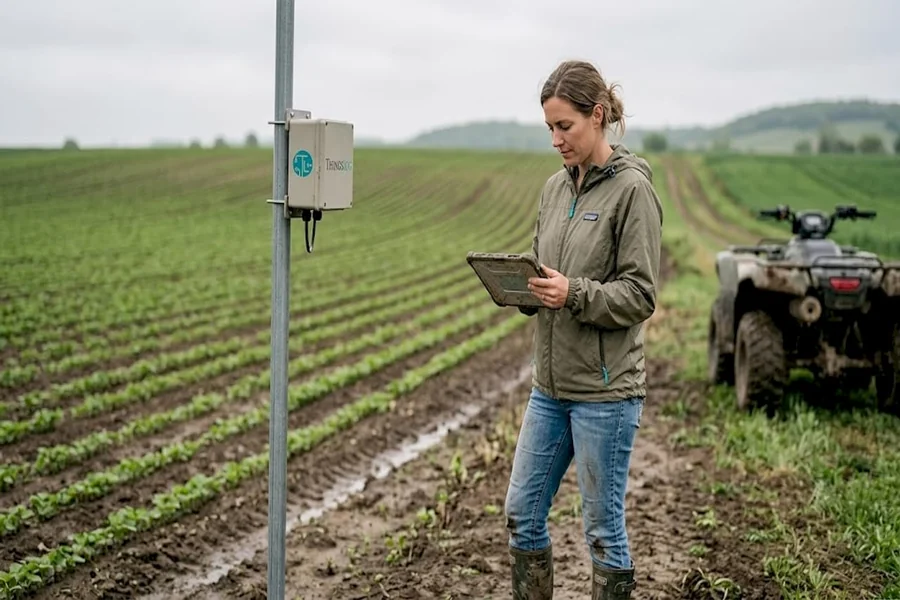
On a large farm, LoRaWAN and wired sensors do different jobs. Wired signals suit control, where equipment must react at once. LoRaWAN suits monitoring across distant buildings, where cabling is impractical and internet access is missing.
In a study run between October 2020 and February 2022 on three pig farms in Schleswig-Holstein, Germany, researchers at Kiel University logged ammonia every 15 minutes above a pen for two batches per farm, using a sensor from the manufacturer dol-sensors. Their assessment came with a practical condition: the sensor needs a power supply and the gateway needs internet access, and dol-sensors supplies both. That condition is a useful starting point for a connectivity decision.
Whether LoRaWAN or wired sensing is better for large farms depends on what the signal must do
LoRaWAN, short for Long Range Wide Area Network, is a radio protocol for small, infrequent messages. Its regional parameters, published by the LoRa Alliance, set the LoRa data rates in the European 868 MHz band at 250 to 5,470 bit/s on 125 kHz channels, with a maximum application payload of 51 to 242 bytes per message, depending on data rate. To comply with ETSI regulations, LoRaWAN limits transmissions by duty cycle, to less than 1 % on the default channels.
Those limits shape what the network can do. In a peer-reviewed analysis, Adelantado and colleagues found that LoRaWAN latency is not deterministic and concluded that the technology “cannot claim to be a candidate solution for industrial automation.” In the basic device class, Class A, a sensor can receive a message only after it has sent one. Class C devices keep the downlink open at all times, and dol-sensors offers an RS232 LoRa converter in Class C for continuous two-way communication. Even so, LoRaWAN is a monitoring technology, not a control link.
A wired analog or switched signal has no such constraints. It is present at the controller input at all times, which makes wires the safer choice for control signals to fans, inlets and augers. LoRaWAN earns its place where the task is to see conditions, not to switch equipment.
The best wireless sensor option for remote farm monitoring depends on range, attenuation and backhaul
Range is the main reason to choose LoRa radio. In field tests around Oulu, Finland, researchers recorded maximum LoRa ranges of over 15 km on the ground and close to 30 km over water at 868 MHz. Results from farms are more directly relevant. In a 2022 study on a dairy farm, Fu and colleagues ran a LoRa network at 433 MHz across four cattle houses and measured packet loss below 1 % at distances up to 604 m. The 433 MHz band used in that study is not supported by dol-sensors’ LoRa equipment.
Inside livestock buildings, ranges are shorter than these open-air figures. In a poultry layer facility, Darr and Zhao identified free space, animal cages, animal presence and concrete floors as significant causes of signal loss for the wireless sensor modules they tested, with one fully stocked cage adding about 22.5 dB of path loss and two adding 24.9 dB.
Backhaul, the link from the gateway onward, matters as much as range. The iDOL 64 LoRa Gateway from dol-sensors is one example of a design that does not rely on farm internet: it has a built-in 2G, 3G and 4G modem with a SIM card included for the user to activate and forwards data to the dol-sensors cloud, where software retrieves them through an API. The manufacturer specifies a range of up to 300 m inside livestock buildings, depending on walls and mounting height, and documents the gateway for the European 868 MHz band. The manufacturer’s LoRaWAN sensors for farm monitoring measure ammonia, temperature, humidity, CO2 and water consumption.
What each option needs for power and robustness
Long battery life is one of the defining goals of low-power wide-area networks such as LoRa. That goal covers the radio, not necessarily the sensor. The iDOL 53 LoRa Ammonia Sensor from dol-sensors illustrates the point: its battery, with an estimated life of five years at 10-minute sampling and good signal conditions, powers only the LoRa converter and cannot back up the sensor, so the unit runs on a 100 to 240 V AC supply.
Wired installations have weak points of their own. National Instruments notes that voltage signals lose accuracy over long cables because of wire resistance, and that ground loops form when two connected points sit at different ground potentials. Its recommended remedy for ground loops is isolation at the measuring device. For its own wired sensors, dol-sensors recommends cable runs of no more than 100 m (about 330 ft) with a conductor cross-section of at least 0.75 mm².
What output signals farm sensors typically use, and how to protect them from electrical noise
Wired farm sensors typically deliver one of three signals: an analog voltage such as 0-10 V, an analog current of 4-20 mA or a switched output that turns equipment on and off. Current loops have been used for process monitoring and control since the 1950s, and National Instruments attributes their use in industry to better noise immunity and longer possible cable runs. In a 4-20 mA loop, 4 mA is a “live zero” and 0 mA signifies a break in the loop, so a broken wire shows up as a fault rather than as a false reading.
In practice, current outputs are the better choice for long runs where the controller accepts them. Some sensors offer both types; dol-sensors’ DOL 18 Sub-pressure Sensor, for example, is available with a 4-20 mA output, a 0-10 V or 0-5 V output selected by DIP switch, or both. A radio link avoids long analog cables altogether, which removes this particular noise path but introduces the attenuation and latency limits described above.
How to integrate sensors into existing feeding systems and OEM controllers
Auger control uses switched outputs, because the signal starts and stops a motor. Capacitive proximity sensors, which detect loose materials such as feed, are one way to generate that signal. In dol-sensors’ DOL 26 range, the SCR version runs on 20 to 280 V AC/DC over two wires connected in series with the load, while the PNP and NPN versions run on 10 to 36 V DC; the manufacturer lists them for use with contactors, relays and PLCs.
For OEMs and integrators, the two routes deliver data differently. Wired outputs enter the control logic directly. LoRaWAN data arrive through a gateway and a cloud interface, which suits dashboards, alarms and records across sites. The Fu study shows that remote switching over LoRa is possible, with most instructions executed in less than 10 s. That is fast enough for remote operation, but too slow for a feeding line that must react at once.
| Criterion | Wired sensors | LoRaWAN sensors |
| Suited to | Control of fans, inlets and augers | Monitoring across buildings and sites |
| Latency | Signal present at the controller at all times | Not deterministic; in Class A, downlink only after an uplink |
| Range | Limited by wire resistance, especially for voltage signals | Kilometers outdoors; less through barn structures, cages and animals |
| Power | Supplied through the sensor cable | Battery for the radio; mains for sensors with a higher draw |
| Electrical noise | 4-20 mA and isolation reduce the risk | No long analog cable; radio attenuation instead |
How to wire multiple sensors in a feeding line
Several switched sensors can be wired in series so that a motor runs only when all conditions are met. The manufacturer dol-sensors describes a typical case: one sensor in the hopper and one in the feed bowl, wired in series, so the output activates only when both detect feed. The company’s SCR SE series is designed specifically for connecting several sensors in series.
What neither option does on a large farm
LoRaWAN does not replace the wired link between a sensor and the equipment it controls, and its range inside buildings depends on cages, animals and walls. Frequency plans differ by region, so equipment documented for Europe has to be confirmed for other markets. Wired sensors, for their part, need cabling that is planned for length, signal type and grounding. Neither route compensates for a sensor that is not specified for the barn it hangs in.
A connectivity checklist for large farms
On farms with spread-out buildings, both technologies usually have a place. Some manufacturers offer wired and LoRaWAN versions of sensors for the same measurement, which lets growers match the connection to the job; dol-sensors, for example, makes the DOL 53 and the iDOL 53 LoRa for ammonia.
- Keep anything that switches a motor, auger or fan on a wired signal
- Choose 4-20 mA outputs for long wired runs if the controller accepts them; dol-sensors’ LoRa gateway does not currently accept 4-20 mA
- Wire feed sensors in series where an auger should run only when several conditions are met
- Use LoRaWAN where buildings are far apart or local internet is missing
- Test radio coverage inside stocked buildings before deciding on a gateway position
- Check the region’s frequency plan and cellular coverage before buying a gateway
- Check whether a wireless sensor needs mains power for its measuring element, even when its radio runs on battery