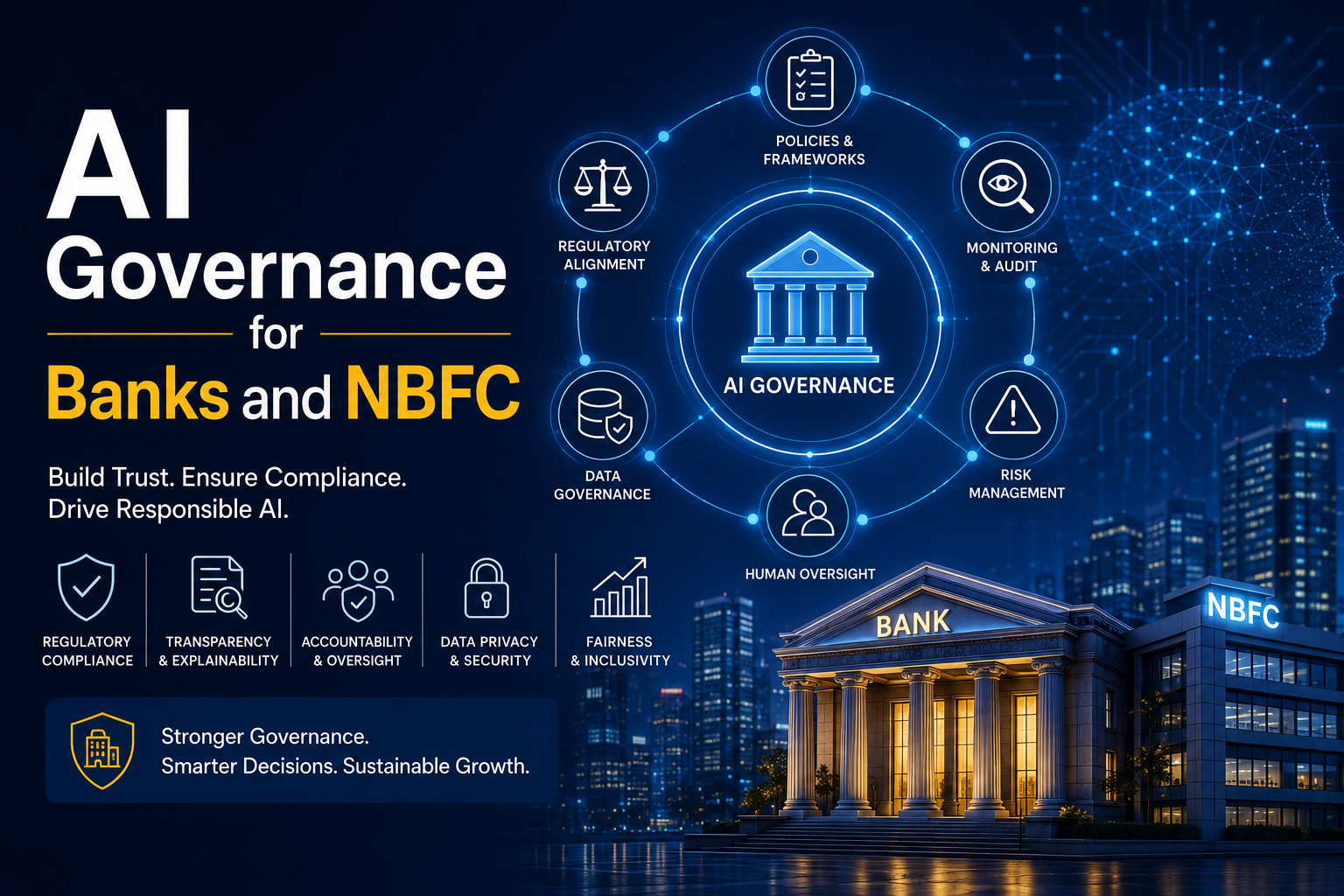
Introduction
Generative AI copilots draft credit memos. Autonomous agents triage customer service tickets, chase collections, and pull data from core banking systems on their own initiative. Underwriting models score loan applications in milliseconds; fraud engines flag transactions before a human analyst has finished their coffee. For banks and non-banking financial companies (NBFCs), AI has stopped being an experiment and become working infrastructure — embedded in credit decisioning, fraud detection, anti-money-laundering (AML) automation, wealth advisory, and the customer support layer that touches millions of retail accounts every day.
The pace of that adoption is the problem as much as the opportunity. AI governance for banks has become urgent precisely because AI systems in financial services now make or influence decisions with real regulatory, financial, and reputational consequences — and most institutions built their model risk programs for a world of static, well-documented statistical models, not for stochastic large language models (LLMs) and autonomous agents that reason, call tools, and act with a degree of independence traditional model validation was never designed to test.
Regulators are not waiting for the industry to catch up. The Reserve Bank of India’s FREE-AI framework, the European Union’s AI Act, the EU’s Digital Operational Resilience Act (DORA), the Monetary Authority of Singapore’s FEAT principles, the UK FCA and PRA’s SS1/23 expectations, and the U.S. Federal Reserve’s long-standing SR 11-7 model risk guidance are converging on the same message: AI deployed in financial services must be governed, monitored, and auditable — not just validated once and left to run.
This article lays out a practical, operational framework for AI governance in banking: what it actually means beyond model validation, why it matters now, the eight pillars that make a governance program work in practice, how governance changes across the AI lifecycle and for autonomous agents specifically, and a phased roadmap institutions can use to move from ad-hoc oversight to continuous, audit-ready assurance.
What Is AI Governance in Banking?
AI governance in banking is the combination of policies, controls, and continuous oversight mechanisms that ensure every AI system — model, LLM application, or autonomous agent — behaves within approved risk boundaries throughout its entire lifecycle, and that the institution can prove it did. It is broader than model validation. Traditional model risk management asks whether a model is statistically sound at the point of approval. AI governance asks a continuous question: is this system still behaving safely, today, in production, given the data, prompts, and tool access it actually has right now?
A working AI governance program for banks and NBFCs typically spans seven capabilities:
- Policy — documented, board-approved rules for what AI systems are permitted to do, and under what conditions
- Monitoring — continuous, runtime observation of AI behavior in production, not just pre-launch testing
- Human oversight — defined checkpoints where a human must review, approve, or can override an AI decision
- Runtime controls — inline enforcement that blocks or corrects unsafe outputs and actions as they happen
- Explainability — the ability to show why an AI system reached a particular decision or took a particular action
- Compliance — mapping of AI behavior and controls to the specific regulatory obligations that apply to the institution
- Security and auditability — protection against manipulation of AI systems, and a durable evidence trail for examiners
Traditional Model Governance vs Enterprise AI Governance
| Dimension | Traditional Model Governance | Enterprise AI Governance |
| Validation cadence | Point-in-time, typically annual | Continuous, runtime, always-on |
| Scope of oversight | Statistical models with fixed inputs/outputs | LLMs, copilots, RAG pipelines, and autonomous agents |
| Failure modes covered | Drift, bias, overfitting | Hallucination, prompt injection, data leakage, tool misuse, agent autonomy risk |
| Evidence produced | Periodic validation reports | Continuous audit trail of prompts, decisions, and actions |
| Human role | Reviews model documentation at approval | Approves, overrides, and intervenes on live decisions |
| Who is covered | Models built and owned in-house | In-house models plus third-party LLMs, vendor AI, and shadow AI |
Neither replaces the other — AI governance builds on model risk management foundations (data lineage, documentation, independent review) while adding the runtime, behavioral, and agentic controls that stochastic AI systems demand.
Why Banks & NBFCs Need AI Governance
Every one of the following risks has already surfaced in production financial-services deployments, and each is difficult or impossible to catch with annual model validation alone.
AI hallucinations
An LLM-powered advisory tool or customer service copilot can generate plausible-sounding but factually wrong information about interest rates, fees, or product eligibility — creating mis-selling and consumer-protection exposure the moment a customer acts on it.
Unauthorized decisions and agent autonomy
As banks move from single-turn chatbots to multi-step agents that can query core systems, adjust account flags, or initiate workflows, the risk shifts from “wrong answer” to “wrong action.” An agent with excess tool access can take a consequential step — a refund, a limit change, an escalation — without the human-in-the-loop checkpoint the institution assumed was in place.
Data leakage and prompt injection
Employees pasting customer PII into public LLM tools, and hidden instructions embedded in emails, documents, or web content that hijack an agent’s behavior, are both now recognized attack surfaces that traditional DLP and perimeter security were never built to see.
Shadow AI
Business units adopt AI copilots and browser extensions faster than IT and risk teams can inventory them, leaving institutions unable to answer a basic examiner question: what AI systems are actually running against our data today?
Model drift, bias, and lack of audit trails
Credit and underwriting models can drift in accuracy or develop disparate impact across demographic or geographic subgroups as the population they score changes — and without continuous monitoring and logged decision trails, that drift is invisible until a regulator, auditor, or complaint surfaces it.
Third-party LLM risk
Most banks build AI applications on foundation models from OpenAI, Anthropic, Google, or others. The institution doesn’t control the underlying model, but under every major regulatory framework it remains fully accountable for how that model behaves in its products.
Individually, each of these is a known category of operational, security, or compliance risk. Without a governance layer that spans all of them continuously, they compound — and they compound fastest in exactly the high-volume, customer-facing, decision-making use cases banks are racing to deploy AI into.
The 8 Pillars of Enterprise AI Governance
1. AI Inventory & Discovery
Why it matters: You cannot govern what you cannot see. Most institutions underestimate how many AI systems — sanctioned and unsanctioned — are already touching customer data.
Banking use case: A CDO discovers, through an inventory sweep, that three business units are using different LLM-powered document extraction tools for KYC processing, none of which were formally risk-assessed.
Best practice: Maintain a living AI system registry covering every model, LLM application, copilot, and agent — including owner, purpose, data accessed, and risk tier — refreshed continuously, not annually.
Risk if ignored: Shadow AI operates outside every other control in this list. An institution can’t apply policy, monitoring, or audit evidence to a system it doesn’t know exists.
2. AI Risk Classification
Why it matters: Not every AI system carries the same risk. A credit-decisioning agent needs materially tighter controls than an internal document summarizer.
Banking use case: A model risk team tiers systems by decision impact, customer exposure, and autonomy level, applying the heaviest controls to underwriting and AML systems and lighter-touch monitoring to internal productivity tools.
Best practice: Classify by potential harm (financial, consumer, reputational), not by technical complexity — a simple rules-based tool making high-stakes credit decisions can warrant more scrutiny than a sophisticated but low-stakes internal copilot.
Risk if ignored: Applying uniform, one-size-fits-all controls either under-protects high-risk systems or creates so much friction on low-risk tools that teams route around governance entirely.
3. AI Policy Management
Why it matters: Board-approved policy translates regulatory expectation and institutional risk appetite into rules an AI system can actually be checked against.
Banking use case: A bank’s AI policy defines that no customer-facing agent may disclose specific credit decision reasoning without a compliance-approved template, enforced automatically rather than left to individual prompt design.
Best practice: Centralize policy in a single engine that every AI system is checked against, rather than embedding rules separately inside each application, which drifts out of sync quickly.
Risk if ignored: Policy that exists only as a PDF on an intranet has no mechanism to prevent violation — it documents intent without enforcing behavior.
4. Runtime AI Monitoring
Why it matters: AI behavior can change after deployment as prompts, data, and usage patterns evolve — a system approved in testing is not guaranteed to behave the same way in production six months later.
Banking use case: A fraud-detection LLM’s false-positive rate creeps upward over several weeks as transaction patterns shift; runtime monitoring flags the drift before it produces a backlog of wrongly frozen accounts.
Best practice: Monitor behavioral baselines continuously — accuracy, hallucination rate, latency, and anomalous tool calls — not just uptime and throughput.
Risk if ignored: Point-in-time testing gives a snapshot of behavior on day one and says nothing about day ninety, which is exactly when drift, manipulation, or edge-case failures tend to appear.
5. Human-in-the-Loop Controls
Why it matters: Regulators consistently expect that AI augments human judgment rather than fully replacing it for consequential decisions.
Banking use case: A loan underwriting agent can pre-populate a recommendation and supporting rationale, but final approval above a defined exposure threshold routes to a human underwriter before disbursal.
Best practice: Define approval checkpoints by decision consequence, not by AI system, so the same agent might act autonomously on low-stakes tasks and require sign-off on high-stakes ones.
Risk if ignored: Without defined override points, “human-in-the-loop” becomes a compliance slide rather than an operational reality, and the human reviewer has no real ability to intervene before harm occurs.
6. AI Explainability & Audit Trails
Why it matters: When a customer disputes a credit decision or an examiner asks why an AI system acted a certain way, “the model said so” is not an acceptable answer.
Banking use case: A compliance officer reconstructs, from logged traces, exactly what data an AML alert-triage agent reviewed and what rule triggered its escalation, in response to a regulatory inquiry.
Best practice: Log decision rationale, data lineage, and action history at the point of execution — reconstructing it after the fact from application logs alone is rarely possible.
Risk if ignored: Without contemporaneous audit evidence, institutions face examiner findings, delayed dispute resolution, and an inability to demonstrate compliance even when the underlying decision was sound.
7. AI Security & Access Governance
Why it matters: AI systems, particularly agents with tool access, introduce a new attack surface — prompt injection, data exfiltration through legitimate-looking tool calls, and credential misuse — that traditional application security wasn’t built to test.
Banking use case: Adversarial testing against a customer service agent reveals it can be manipulated, through a crafted message, into revealing another customer’s account summary.
Best practice: Apply role-based access control to what data and tools each AI system can reach, and red-team agents against prompt injection and tool-misuse scenarios before and after deployment.
Risk if ignored: An unguarded agent with broad tool access is a single successful manipulation away from a data breach or unauthorized transaction — and the exposure scales with every new capability the agent is granted.
8. Continuous Compliance & Reporting
Why it matters: Banks now face overlapping obligations — RBI, EU AI Act, DORA, MAS, FCA — each with its own documentation and reporting expectations, on different timelines.
Banking use case: A compliance team generates board-ready evidence of AI risk posture ahead of a quarterly review, without a multi-week manual evidence-gathering exercise across business units.
Best practice: Automate evidence generation from the same underlying monitoring and audit data used operationally, so compliance reporting reflects reality rather than a retrospective reconstruction.
Risk if ignored: Manual, quarterly compliance reporting cannot keep pace with regulatory expectations for continuous oversight, leaving institutions perpetually behind the evidence examiners actually ask for.
AI Governance Across the AI Lifecycle
Governance obligations change shape at each stage of an AI system’s life. Treating it as a single pre-launch checklist is the most common reason governance programs fail to catch problems that only appear once a system is live.
| Lifecycle Stage | Governance Focus |
| Ideation | Define intended use, risk tier, and regulatory scope before any build begins |
| Development | Document data lineage, model/prompt design choices, and known limitations |
| Testing | Adversarial red-teaming, bias and hallucination benchmarking, policy conformance checks |
| Deployment | Access controls, human-approval checkpoints, and rollback plans confirmed before go-live |
| Production | Runtime monitoring, inline guardrails, and incident response active from day one |
| Continuous Monitoring | Ongoing drift detection, behavioral baselining, and periodic re-evaluation |
| Retirement | Formal decommissioning, access revocation, and retained audit evidence for the required retention period |
The stages that most banking AI governance programs still treat lightly are production and continuous monitoring — precisely the stages where an LLM or agent spends the overwhelming majority of its operating life, and where behavior is most likely to diverge from what was tested.
AI Agent Governance in Banking
Autonomous agents require materially stronger governance than single-turn AI models because they don’t just generate an output — they take actions, hold memory across sessions, and call tools with real-world consequences. A model that hallucinates produces a wrong answer; an agent that hallucinates a justification for an action can execute it.
Effective agent governance in banking addresses:
- Tool access — which systems, APIs, and data sources an agent can reach, scoped to the minimum required for its task
- Decision boundaries — explicit limits on what an agent may decide autonomously versus what requires escalation
- Memory governance — controls over what an agent retains across sessions, and safeguards against memory or retrieval-augmented generation (RAG) corruption from poisoned or manipulated content
- Runtime permissions — dynamic, context-aware authorization rather than static, one-time access grants
- Approval workflows — defined checkpoints where a human must confirm an action before it executes
- Action logging — a full record of what an agent did, what triggered it, and what data or tools it touched
- Human override — the practical ability to interrupt or reverse an agent action mid-workflow, not just after the fact
- Policy enforcement — inline blocking of actions that violate defined rules, at the point of execution
- Risk scoring — continuous assessment of an agent’s behavior against its established baseline, flagging deviation
| Banking scenario: the confused-deputy pattern
A collections agent with legitimate access to a customer’s account is manipulated — through a crafted email the agent processes as part of a routine task — into disclosing account details to an unauthorized party. The agent isn’t malicious; it’s a “confused deputy,” tricked into misusing privileges it was correctly granted for a different purpose. Traditional access controls don’t catch this because the agent’s credentials were valid — only behavioral monitoring and tool-call policy enforcement catch it in time. |
This is the core reason agent governance can’t simply extend traditional model risk tooling: the failure modes are behavioral and action-based, not statistical, and they require monitoring designed around tool use, memory, and multi-step reasoning rather than input-output accuracy alone.
Practical AI Governance Framework for Banks
Institutions building or maturing an AI governance program can follow a six-phase roadmap that moves from visibility to continuous, automated assurance:
| Phase | Focus | What It Delivers |
| Phase 1 | AI Discovery | Inventory every AI system in use — sanctioned and shadow — across the institution, including third-party and vendor-embedded tools. |
| Phase 2 | Risk Assessment | Classify each system by decision impact, data sensitivity, customer exposure, and autonomy level. |
| Phase 3 | Policy Definition | Codify board-approved rules for each risk tier into a centralized, enforceable policy set. |
| Phase 4 | Deployment Governance | Confirm access controls, human-approval checkpoints, and rollback plans before any system reaches production. |
| Phase 5 | Runtime Monitoring | Continuously observe behavior, drift, and anomalies once systems are live. |
| Phase 6 | Compliance Automation | Generate audit-ready evidence and regulatory reporting directly from monitoring and policy-enforcement data. |
Institutions rarely move through these phases in a strict sequence — most run discovery and risk assessment continuously while parallel-tracking policy definition for their highest-risk systems first, then extending coverage outward.
Regulatory Landscape
RBI expectations — FREE-AI
The RBI’s Framework for Responsible and Ethical Enablement of AI (FREE-AI) is built around seven guiding “sutras” and six strategic pillars — Infrastructure, Policy, Capacity, Governance, Protection, and Assurance — translated into 26 actionable recommendations. It applies to scheduled commercial banks, NBFCs, and other RBI-regulated entities, and extends accountability to fintech and cloud partners those institutions rely on. RBI’s own surveys found that roughly a fifth of regulated entities were already deploying AI in production, concentrated in customer support, sales, credit underwriting, and cybersecurity — with a much larger share expressing near-term intent to expand. Expected next steps for regulated entities include a board-approved AI policy, a named governance owner, an internal AI sandbox, and an independent audit and impact-assessment program.
EU AI Act
The EU AI Act classifies AI systems used in credit scoring and other essential financial services as high-risk, triggering conformity assessment, technical documentation, and human-oversight obligations. The original 2 August 2026 deadline for standalone high-risk (Annex III) systems has, following political agreement in mid-2026, been set for deferral to 2 December 2027, with AI embedded in regulated products (Annex I) moved to 2 August 2028 — though this remains subject to formal adoption and institutions with EU exposure should continue preparing against the original timeline until that adoption is confirmed.
DORA
The EU’s Digital Operational Resilience Act treats AI systems used by financial entities as part of the ICT risk landscape subject to operational resilience testing, third-party risk management, and incident reporting obligations — relevant wherever AI systems sit in a bank’s critical operational chain.
NIST AI RMF and ISO 42001
The U.S. NIST AI Risk Management Framework and the international ISO/IEC 42001 standard for AI management systems provide voluntary but increasingly referenced structures — govern, map, measure, manage for NIST; a certifiable management-system model for ISO 42001 — that many institutions use as the operational backbone underneath jurisdiction-specific rules.
The practical challenge is not any single framework — it’s that RBI, EU AI Act, DORA, MAS FEAT, and FCA/PRA expectations arrive on different timelines with different documentation formats but overlapping underlying requirements: an AI inventory, risk classification, board-level accountability, audit trails, and independent assurance. A governance program built once around those shared requirements can generate evidence for multiple regulatory frameworks simultaneously, rather than running parallel compliance efforts for each.
Common Mistakes Banks Make
Across institutions building AI governance programs, the same gaps recur:
- Validating models only annually, leaving nine to twelve months of unmonitored production behavior between reviews
- No centralized AI inventory, so risk and compliance teams cannot answer “what AI is running against our data today”
- No runtime monitoring — testing happens pre-launch and stops the moment a system goes live
- No prompt or output monitoring for LLM applications, leaving hallucination and mis-selling risk invisible until a complaint surfaces it
- No AI-specific access controls, relying on generic application security that wasn’t designed for tool-calling agents
- No governance framework for AI agents specifically, treating them as if they carry the same risk profile as static models
- No centralized policy engine, leaving rules embedded inconsistently across individual applications
- No audit evidence generated automatically, forcing manual reconstruction under time pressure when an examiner asks
Each of these gaps is individually manageable. Left uncorrected together, they compound into exactly the evidence gap regulators are now testing for: continuous monitoring and audit trails, not quarterly reports.
How Trusys.ai Enables AI Governance
Trusys.ai is built as the operations layer underneath the framework described above — providing the AI inventory, risk classification, runtime monitoring, policy enforcement, and audit-ready evidence that continuous AI governance in banking requires.
The platform’s capabilities map directly onto the eight pillars covered earlier:
AI inventory and risk classification: Argus, Trusys’s autonomous governance orchestration layer, maintains a continuously updated AI system inventory with per-system risk classification, closing the visibility gap that undermines every other control.
Pre-deployment evaluation: TruEval runs behavioral evaluation on how AI systems and agents actually perform — tool use, multi-turn reasoning, and memory persistence — against banking-relevant benchmarks, rather than testing prompts in isolation.
Adversarial testing: TruScout red-teams agents and LLM applications against the OWASP LLM and Agentic AI Top 10 and MITRE ATLAS, surfacing prompt-injection, RAG-poisoning, and tool-misuse vulnerabilities before they reach production.
Runtime monitoring: TruPulse traces every agent action with full lineage — what triggered it, what data it touched, what tools it called — detecting behavioral drift and confused-deputy patterns the moment they appear in production, not at the next scheduled review.
Inline policy enforcement: TruGuard enforces guardrails at an agent’s input, output, and action layers — blocking injection attempts, enforcing data-classification rules, and preventing unauthorized tool use without modifying the underlying agent.
Audit-ready compliance evidence: Argus generates continuous, automatic evidence mapped to RBI FREE-AI, the EU AI Act, DORA, ISO 42001, and NIST AI RMF, reducing the manual reconstruction burden compliance teams otherwise face ahead of examiner reviews.
Trusys is designed to augment existing model risk and validation teams rather than replace them, and it is independent of any foundation model or cloud provider — it has no commercial conflict when testing surfaces a weakness in any given model. For institutions evaluating where their current AI governance maturity stands relative to RBI, EU AI Act, and DORA expectations, the
Trusys AI governance page for banks and NBFCs outlines jurisdiction-specific coverage in more detail.
Best Practices Checklist
- Build and maintain a complete AI system inventory, including shadow AI
- Classify every AI system by decision impact and customer exposure
- Secure board approval for a written AI governance policy
- Assign a named executive accountable for AI risk
- Define human-approval checkpoints scaled to decision consequence, not to system type
- Red-team every customer-facing agent against prompt injection before launch
- Monitor runtime behavior continuously, not just at pre-launch testing
- Log decision rationale and action history at the point of execution
- Apply least-privilege tool and data access to every agent
- Test for bias and disparate impact across demographic and geographic subgroups
- Map controls to every applicable regulatory framework simultaneously, not one at a time
- Establish an internal AI sandbox for pre-production testing
- Review AI risk at the board level on a quarterly cadence
- Require vendor and third-party AI providers to meet the same governance standards as in-house systems
- Define and rehearse an incident-response plan specific to AI failures
- Automate compliance evidence generation rather than reconstructing it manually
- Set explicit memory-retention and RAG-freshness controls for agents
- Establish a formal decommissioning process for retired AI systems
- Provide AI-specific training to risk, compliance, and audit teams
- Revisit risk classification whenever a system’s scope, data access, or autonomy changes
Future of AI Governance in Banking
As banks move from single-purpose copilots toward agentic AI — systems that plan, use tools, and coordinate with other agents across a workflow — governance itself has to become more autonomous to keep pace. Point-in-time human review cannot scale to the speed and volume at which agent-based systems operate.
Three shifts are already visible in how leading institutions are approaching this:
- Real-time governance — moving from periodic review cycles to continuous, always-on evaluation and enforcement
- Continuous assurance — replacing point-in-time audits with an ongoing evidence stream examiners can query directly
- Adaptive, governance-by-design policies — building controls into agent architecture from the start, rather than retrofitting oversight onto systems already in production
Governance is on a trajectory to become foundational infrastructure for enterprise AI in banking — as fundamental to how institutions operate AI as core banking platforms are to how they operate transactions. Institutions that build this capability now, ahead of the next wave of agentic deployment, will be positioned to scale AI adoption without scaling risk alongside it.
Conclusion
AI adoption in banking is not slowing down, and neither is regulatory scrutiny of it. Governance is what allows the two to coexist — it’s the difference between an institution that can confidently scale AI-driven underwriting, fraud detection, and customer service, and one that discovers its exposure only after an examiner, a customer complaint, or an incident forces the issue. The eight pillars, lifecycle discipline, and phased roadmap covered here give CIOs, CROs, compliance leaders, and AI teams a practical structure to assess where their current program stands and what to build next.
Discover how Trusys.ai helps banks and NBFCs govern AI models, AI agents, and enterprise AI systems with continuous monitoring, policy enforcement, and audit-ready compliance.
SEO & Distribution Package
1. SEO Title (under 60 characters)
AI Governance for Banks & NBFCs | Trusys.ai
2. Meta Description (150-160 characters)
A practical AI governance framework for banks & NBFCs: 8 pillars, lifecycle controls, agent governance, and RBI, EU AI Act & DORA compliance.
3. URL Slug
/blog/ai-governance-for-banks-nbfcs-practical-framework
4. Suggested Featured Snippet
AI governance in banking is the combination of policies, runtime monitoring, human oversight, and audit controls that ensure AI models, LLM applications, and autonomous agents operate within approved risk boundaries throughout their lifecycle — and that the institution can prove it, continuously, to regulators like the RBI, EU AI Act authorities, and DORA supervisors.
5. FAQs
Q1. What is AI governance for banks?
AI governance for banks is the set of policies, monitoring systems, and human-oversight controls that ensure AI models, LLM applications, and autonomous agents used in banking behave safely and within regulatory boundaries — continuously, not just at the point of initial approval.
Q2. How is AI governance different from traditional model risk management?
Traditional model risk management validates statistical models at a point in time, typically annually. AI governance extends that with continuous runtime monitoring, behavioral controls for LLMs and agents, and audit trails designed for stochastic systems whose behavior can shift after deployment.
Q3. Does RBI require AI governance for banks and NBFCs?
The RBI’s FREE-AI framework, built around seven guiding sutras and six strategic pillars, sets out expectations — including a board-approved AI policy, a named governance owner, and independent audits — for all RBI-regulated entities, including banks, NBFCs, and payment system operators.
Q4. What is the EU AI Act deadline for banks?
High-risk AI systems under the EU AI Act, including AI used in credit scoring, were originally subject to obligations from 2 August 2026. Following political agreement in 2026, that deadline is set to move to 2 December 2027 for standalone high-risk systems, pending formal adoption — institutions with EU exposure should track this closely and prepare against the original date until adoption is confirmed.
Q5. How does DORA relate to AI governance?
DORA treats AI systems used by EU financial entities as part of the ICT risk landscape, subject to operational resilience testing, third-party risk management, and incident reporting — relevant wherever AI sits in a bank’s critical operational chain.
Q6. Why do AI agents need stronger governance than traditional AI models?
Agents don’t just generate outputs — they take actions, hold memory across sessions, and call tools with real consequences. This creates failure modes like confused-deputy data exfiltration and tool misuse that traditional model monitoring wasn’t built to detect.
Q7. What is Shadow AI and why does it matter for banks?
Shadow AI refers to AI tools and copilots adopted by business units without formal risk review or IT visibility. It matters because it operates outside every other governance control — an institution cannot apply policy or monitoring to a system it doesn’t know exists.
Q8. What are the core pillars of enterprise AI governance?
AI inventory and discovery, risk classification, policy management, runtime monitoring, human-in-the-loop controls, explainability and audit trails, security and access governance, and continuous compliance reporting.
Q9. How often should banks monitor AI systems in production?
Continuously. Point-in-time validation only captures behavior at launch; AI behavior can drift as data, usage patterns, and prompts evolve, so runtime monitoring needs to run for as long as the system is in production.
Q10. How does Trusys.ai help banks with AI governance?
Trusys provides AI inventory and risk classification through Argus, pre-deployment evaluation through TruEval, adversarial red-teaming through TruScout, runtime observability through TruPulse, and inline policy enforcement through TruGuard — generating audit-ready evidence mapped to RBI, EU AI Act, DORA, and ISO 42001.