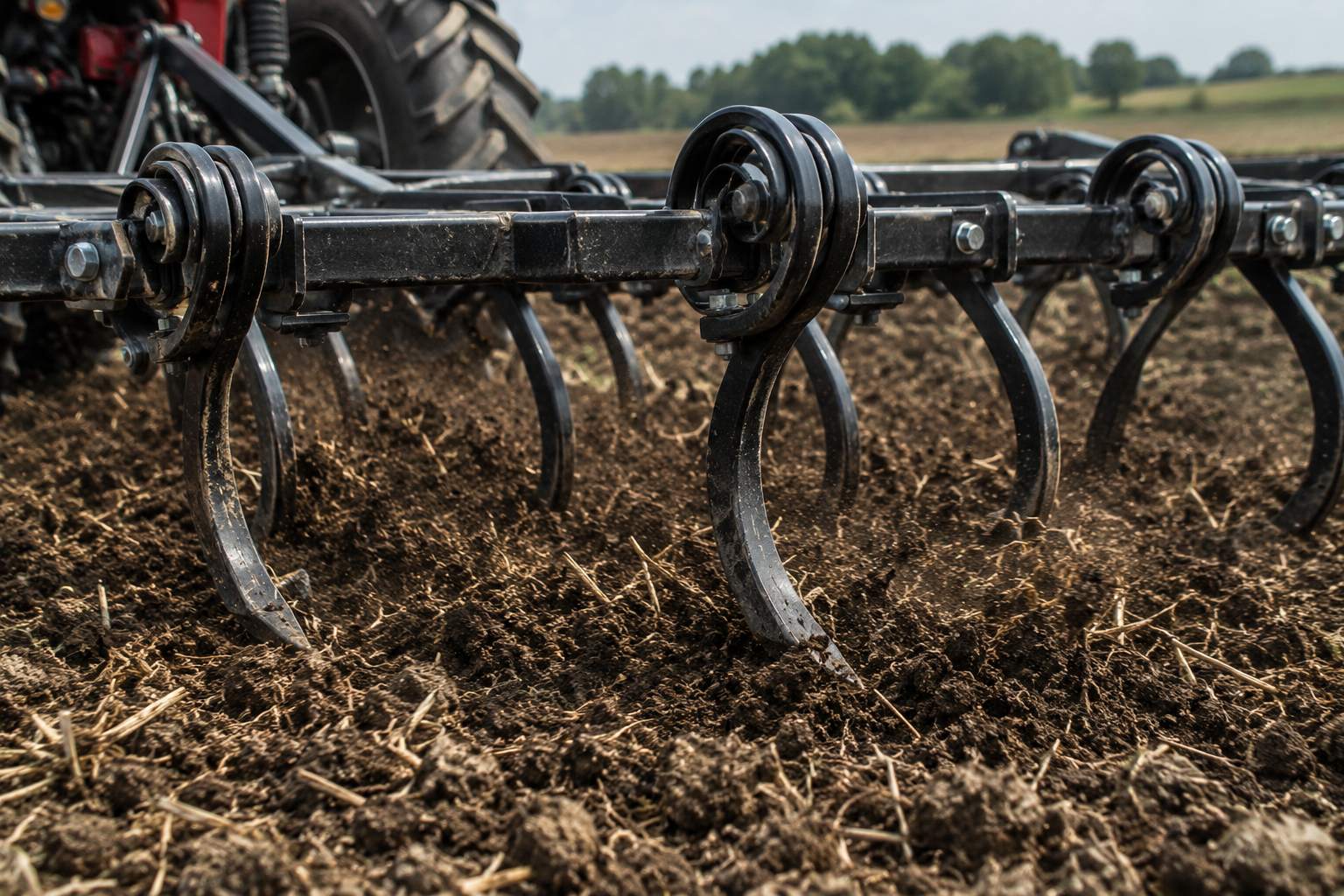
Purchasing teams often replace spring tooth harrow teeth far more often than the equipment actually requires, because the decision gets made on unit price rather than steel specification. That habit costs more in downtime than it ever saves in procurement. A closer look at what causes premature failure tells a different story.
Why Spring Tooth Harrow Teeth Fail Before Their Time
Procurement teams tend to assume spring tooth harrow teeth are interchangeable, just steel bent into the same curved shape, so the buying decision comes down to price per unit. In practice, two teeth can look identical and still perform completely differently in the field. The difference sits inside the metal, not on its surface. Most premature failures trace back to inconsistent hardening and tempering of the spring steel rather than to the mechanical load the soil puts on the tooth.
A tooth hardened too aggressively turns brittle and snaps under repeated flex cycles, because the rapid quench leaves internal stresses the steel never fully relaxes. One tempered too softly loses its spring-back and stays bent after a handful of passes through compacted or stony ground. Both failure modes get blamed on tough soil conditions when the actual cause sits in the heat-treatment furnace. Buyers who understand this distinction start asking suppliers for hardness certificates instead of a price per unit, and that single question changes how they evaluate spring tooth harrow teeth from then on.
The Metallurgy Behind Reliable Harvester Tines
Steel grade and cross-section profile determine how a tooth behaves under cyclic flex, and that behavior separates a component that lasts one season from one that lasts five. Silicon-manganese spring steels, tempered to a defined hardness band around 45-50 HRC rather than a rough approximation, hold their flex characteristics through tens of thousands of load cycles. Push the tempering temperature even 20-30 degrees off target and the material’s fatigue resistance drops sharply, even though the part looks and measures exactly the same on delivery.
This is where a properly specified batch of harvester tines earns its keep. Consistent hardness across a production run means every tooth in the harrow flexes the same way, so wear spreads evenly instead of concentrating on the weakest outliers. Uneven hardening within a batch is often the real reason a fleet operator sees random failures scattered across a season, with no obvious pattern tied to soil type or hours of use. In practice, a handful of teeth from a fresh batch sometimes bend on the first pass through frozen ground while the rest of the set holds its shape for years. That pattern usually points to a furnace run held outside a tight tolerance band, not to the wrong steel grade, a distinction most fleet managers never hear when a supplier processes a warranty claim.
Hagens’ Approach to Specialized Industrial Springs
Hagens has spent years supplying custom spring components to industrial and agricultural equipment manufacturers, and that background shapes how the company approaches harrow teeth. Standard catalog components get produced to a generic tolerance range built to work across many unrelated applications. A tooth engineered for one specific harrow configuration and working load performs differently in a given soil condition, because tolerances and hardness targets get set for that exact use case rather than for the widest possible market; profile geometry follows the same logic. Manufacturers who source harvester tines this way typically see fewer field returns tied to inconsistent batches. More background on that manufacturing approach is available at hagens.com.
Matching Teeth Specification to Equipment Load
Equipment configuration matters as much as the steel itself. A tine designed for light, sandy soil wears out quickly in dense clay. The steel isn’t inferior; the flex profile and tooth geometry were simply matched to a different load curve.
Buyers evaluating spring tooth harrow teeth for a new equipment order should map two variables before requesting quotes: expected soil resistance across the operating season, and the harrow’s frame spacing and mounting geometry. Working speed matters too, since a harrow run consistently at 8-10 mph flexes each tooth through a wider arc per pass than one run at 4-5 mph, which shortens fatigue life even on steel that would otherwise outlast a slower-running rig.
A tooth specified against those factors, rather than pulled from a generic universal-fit listing, holds its shape far longer under real working conditions. Flex characteristics stay consistent pass after pass instead of degrading unevenly across the set. Hagens works from that same load-mapping logic when specifying tempering and profile for a given order, which is why the total cost of ownership looks different once replacement frequency and downtime get weighed against the initial unit price.
What Premature Failure Actually Costs
Companies that select harrow teeth based on steel specification rather than sticker price consistently report longer service intervals and fewer unplanned equipment stops. The upfront cost difference is small next to what a single unplanned harrow failure costs during a working season, especially in a compressed planting or tillage window when a field crew cannot afford to wait days for a replacement part. That timing risk, more than the per-unit price gap, is the factor procurement teams tend to underweight.